
Journal entries
Enter an ordinary balanced journal with deliberate debit/credit accounts, dates, dimensions and descriptions. Managed journals must be corrected through their owning workflow.
Open this screen
Command launcher → Finance → Journal entry. Choose New, Edit/Search or List only as offered.
When it is available
Available to users whose company roles permit this work. Country, subscription, company settings and the saved record's state can narrow the available controls.
QuickBooks connection
In FOR:LEDGER, supported saved accounting records are sent to QuickBooks Online and supported QuickBooks changes are synchronized back to FOR. Opening a list or preparing an unsaved form does not create a QuickBooks transaction. Synchronization is not guaranteed to be immediate or complete: verify the saved document and its status in FOR. FOR remains your accounting system of record under the Terms. FOR:CEO records the same work in FOR only.
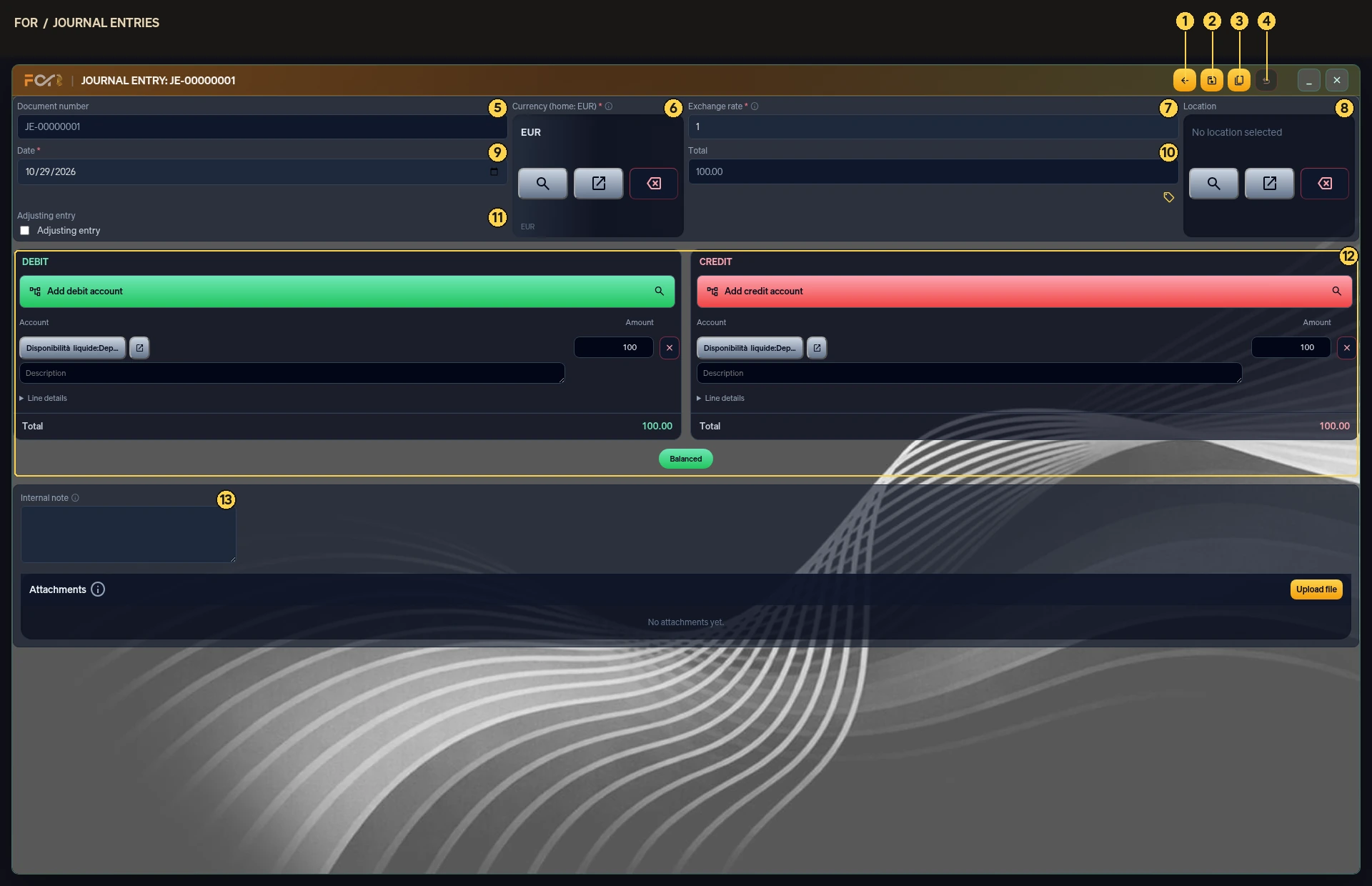
- 1
Back to list · left arrow
Return to the current document list. If the form has unsaved changes, decide explicitly whether to keep working or discard them. Going back is not Save and does not reverse a completed operation.
- 2
Save · disk
Validate and save the current form. On an accounting document this can post the financial transaction; on an operational draft it saves that stage only. Read the success or error message and final number. If the outcome is uncertain, reload/reconcile the same document instead of creating another.
- 3
Clone · overlapping pages
Prepare an independent new form from the last saved source. Unsaved source edits are not copied. Review the new date, number, current party addresses, currency/tax and every line, then explicitly Save. Opening or abandoning the clone creates no accounting transaction.
- 4
Reverse journal · undo
Disabled in this example. Review and confirm one opposite journal on the original date. Both entries remain in the books; it does not erase the original journal.
- 5
Document number
Review the suggested business number/code before saving. Where numbering is managed, the final saved number is authoritative and may advance if another document used the suggestion. Do not change a number to conceal a duplicate or rewrite history.
- 6
Currency
Check which currency applies to this value. Transaction prices and supplier costs may be in a foreign currency, while stock carrying values and company budgets use the stated home-currency basis. Do not change the currency label to perform a conversion.
- 7
Exchange rate
The quoted rate is home-currency units for one unit of document currency. Review the date and whether the rate is a market reference, a manual choice or the already-recorded rate. An existing document's historical rate must not be silently replaced by today's quote.
- 8
Location
Select the existing accounting location using the lookup, checking the displayed identity and context before choosing. The open-record icon reads the selected record when your role permits it; clear removes only the draft selection, not the referenced record.
- 9
Date
Use the business date described by the caption. Document, registration, planned and actual dates have different meanings; the wrong date can put work in a different reporting or fulfillment period. New transaction dates may start at your local today; always verify imported or copied dates.
- 10
Total
Read the calculated/saved amount and its currency. Total is the document value, tax is its tax component, and balance/remaining credit is what is still available after applications. A displayed zero is different from an unavailable value; do not overwrite a result to force reconciliation.
- 11
Adjusting entry
Set the flag only when it describes the actual financial event. It does not reverse another document, settle a balance or replace the correct credit/refund/correction workflow.
- 12
Journal lines
Enter account, description, debit or credit, and applicable party/class/location per row. Total debits must equal total credits. Do not change a system-managed journal through this grid.
- 13
Internal note
Record the business explanation or reference needed to understand this work later. Internal notes are not the customer/vendor message. Keep source references already present and do not put access passwords or payment-card details here.
Complete the task
Enter an ordinary balanced journal with deliberate debit/credit accounts, dates, dimensions and descriptions. Managed journals must be corrected through their owning workflow.
- Set date, number, currency and any adjusting-entry choice. Select the account on each line and use either Debit or Credit for that line.
- Check that total debits equal total credits. A/R and A/P lines need the correct customer/vendor; dimensions must reflect the intended accounting classification.
- Save and review the posted journal. If the document belongs to an asset, recognition plan, bank operation or correction, follow its owner link rather than editing it directly.
Saved, read-only and unavailable states
The saved record and its source workflow determine which fields can change. Read-only values stay visible for review; they are not broken inputs. Save/discard unsaved edits before an action that requires a clean source. If the result of an operation is uncertain, inspect and reconcile that same operation rather than repeating a new write.
Every field and control
Use the exact label or hover over an icon to match it to this reference. A missing action is not the same as an empty field: check its availability below.
Search · magnifying glass
ActionSearch this company's selected list by the visible document number, business name or descriptive words. Confirm the active company first. Search results do not widen your role permissions; clear the search to return to the ordinary filtered list.
Availability: List and lookup views. A source-specific picker can intentionally offer fewer records than the full list.
Include retained inactive/completed records when the list offers this control. Open order views exclude Draft, Closed and Cancelled; completed pick/pack tasks are normally found through Show inactive. Historical visibility does not reactivate or reopen a record.
Availability: Only when the list supports inactive or lifecycle filtering; choices depend on the document type.
Previous / Next / page size
ActionMove through the current filtered result set. The count refers to those filters, not the whole company. Changing filters starts a new result set; a short page does not by itself prove that unrelated records do not exist.
Availability: Paged lists; Previous/Next is disabled when no page exists in that direction.
Open a row
ActionSelect the record's main name/number to open its form. Email and phone links have their own communication actions. A linked count or financial balance can open the corresponding transaction rail rather than edit that total.
Availability: Requires permission to open the record. Reference-only roles receive only the permitted context.
Back to list · left arrow
ActionReturn to the current document list. If the form has unsaved changes, decide explicitly whether to keep working or discard them. Going back is not Save and does not reverse a completed operation.
Availability: Ordinary forms; a guided batch or specialized workflow can manage navigation itself.
Minimize · minus
ActionKeep this workspace open as a colored taskbar tile. Select that tile to restore the same window. Minimizing is not Save and does not cancel an operation already submitted.
Availability: Hosted workspace windows.
Close window · X
ActionClose this window, not the underlying record. Respect any unsaved-change or unfinished-operation warning. Closing a window never reverses a posted document, dispatched shipment or sent email.
Availability: Hosted workspace windows; an active workflow can require waiting or confirming navigation.
New · plus
ActionOpen a new form in the selected company. Check required identity fields, default date, currency and number before entering details. Opening a form is not confirmation of a completed transaction.
Availability: Only for records that can be authored directly and for users with create permission. System activity records have no standalone New.
Save · disk
ActionValidate and save the current form. On an accounting document this can post the financial transaction; on an operational draft it saves that stage only. Read the success or error message and final number. If the outcome is uncertain, reload/reconcile the same document instead of creating another.
Availability: Editable records with write permission; disabled while loading/saving or when a required dependency is unresolved.
Clone · overlapping pages
ActionPrepare an independent new form from the last saved source. Unsaved source edits are not copied. Review the new date, number, current party addresses, currency/tax and every line, then explicitly Save. Opening or abandoning the clone creates no accounting transaction.
Availability: Saved invoices/estimates, eligible ordinary bills, ordinary editable journals, and active eligible Billing Plans. Never for SDI-received bills or managed/tax-adjustment journals. Plan cloning requires a new customer and start/cutoff dates.
Reverse journal · undo
ActionReview and confirm one opposite journal on the original date. Both entries remain in the books; it does not erase the original journal.
Availability: Only when explicitly available on a saved clean document. Linked payments/credits, bank matches, managed entries and closed periods can block it. Italian sales documents additionally need verified Do not send history from the first save; selecting it only now does not qualify an older document.
Check the original correction whose outcome is not yet verified. Do not create another reversal, void or replacement transaction while that outcome is unresolved.
Availability: Only when the saved document has an unfinished correction to reconcile.
Inspect the retained correction history and open the explicitly linked journal when offered. These navigation actions do not issue another correction.
Availability: Records with a retained correction history or linked reversal.
Open eligible choices for this exact field. Search by code/name and inspect the secondary description and badges. Product code matches take priority; Inventory, Non-inventory and Internal only explain eligibility, not interchangeable products.
Availability: Reference fields. Results can depend on customer/supplier, currency, warehouse, source line, active status and your role.
Open selected record
ActionOpen the selected customer, supplier, product, account or source document in its own workspace. Its category color follows the destination. This is navigation, not confirmation of the unsaved current form.
Availability: A resolved reference and permission to open it are required; read-only reference access does not grant master editing.
Clear selection · X
ActionRemove an editable field's current selection. It does not delete the referenced customer/product/document. Changing a party, currency or control account can require confirmation before incompatible draft applications are cleared.
Availability: Only editable, clearable selections; source-owned or required locked references stay protected.
Add row · plus
ActionAdd another editable row to the current document or collection. Select its product/account/source before quantities and values. Adding an empty row does not create the referenced master or post a separate transaction.
Availability: Editable line grids only; received electronic bills, consumed lines and source-owned activity grids may not offer it.
Remove row · minus / trash
ActionRemove an eligible draft row after checking its amount and links. It does not reverse stock already moved or amounts already invoiced. In a draft stock count, minus excludes a row from the count rather than counting it as zero.
Availability: Only where removal is offered and the row is not protected by downstream activity or source evidence.
Choose a supported evidence file, wait for upload completion and review its name before saving. Ordinary form files are limited to 25 MB each. A file upload alone is not a new accounting document or successful email.
Availability: Editable attachment panels. Protected original electronic documents have a separate read-only file area.
Open / download attachment
ActionRead the selected file belonging to this document. Generated invoice PDF, supplier-original attachments and your manually uploaded files can be different files. A pending or failed retrieval is not the same as no attachment.
Availability: Available files and authorized document access. Reading does not modify the bill, trigger a new receipt or resend email.
Remove attachment
ActionRemove only an editable file association after checking that the evidence is no longer required. This does not delete the financial document; protected received originals cannot be removed through this control.
Availability: Only removable, non-protected attachments on an editable form.
Doc #
ColumnRead this saved-record summary before opening the row. Use the full form for the field's context and related documents; a list summary is not an editable posting field.
Availability: Read-only display; inspect the originating workflow to change its result.
Date
ColumnUse the business date described by the caption. Document, registration, planned and actual dates have different meanings; the wrong date can put work in a different reporting or fulfillment period. New transaction dates may start at your local today; always verify imported or copied dates.
Availability: Read-only display; inspect the originating workflow to change its result.
Total
ColumnRead the calculated/saved amount and its currency. Total is the document value, tax is its tax component, and balance/remaining credit is what is still available after applications. A displayed zero is different from an unavailable value; do not overwrite a result to force reconciliation.
Availability: Read-only display; inspect the originating workflow to change its result.
Adjustment
ColumnRead this saved-record summary before opening the row. Use the full form for the field's context and related documents; a list summary is not an editable posting field.
Availability: Read-only display; inspect the originating workflow to change its result.
Document number
FieldReview the suggested business number/code before saving. Where numbering is managed, the final saved number is authoritative and may advance if another document used the suggestion. Do not change a number to conceal a duplicate or rewrite history.
Availability: Editable only when your role, document state and the source workflow allow it; not every country or document variant shows this field. Maximum 21 characters.
Date
FieldUse the business date described by the caption. Document, registration, planned and actual dates have different meanings; the wrong date can put work in a different reporting or fulfillment period. New transaction dates may start at your local today; always verify imported or copied dates.
Availability: Required when this field is offered for an editable record.
Adjusting entry
FieldSet the flag only when it describes the actual financial event. It does not reverse another document, settle a balance or replace the correct credit/refund/correction workflow.
Availability: Editable only when your role, document state and the source workflow allow it; not every country or document variant shows this field.
Currency
FieldCheck which currency applies to this value. Transaction prices and supplier costs may be in a foreign currency, while stock carrying values and company budgets use the stated home-currency basis. Do not change the currency label to perform a conversion.
Availability: Editable only when your role, document state and the source workflow allow it; not every country or document variant shows this field. Lookup results are limited to eligible records; a read-only lookup grants no editing permission.
Exchange rate
FieldThe quoted rate is home-currency units for one unit of document currency. Review the date and whether the rate is a market reference, a manual choice or the already-recorded rate. An existing document's historical rate must not be silently replaced by today's quote.
Availability: Editable only when your role, document state and the source workflow allow it; not every country or document variant shows this field.
Total
FieldRead the calculated/saved amount and its currency. Total is the document value, tax is its tax component, and balance/remaining credit is what is still available after applications. A displayed zero is different from an unavailable value; do not overwrite a result to force reconciliation.
Availability: Read-only display; inspect the originating workflow to change its result.
Location
FieldSelect the existing accounting location using the lookup, checking the displayed identity and context before choosing. The open-record icon reads the selected record when your role permits it; clear removes only the draft selection, not the referenced record.
Availability: Editable only when your role, document state and the source workflow allow it; not every country or document variant shows this field. Lookup results are limited to eligible records; a read-only lookup grants no editing permission.
Journal lines
FieldEnter account, description, debit or credit, and applicable party/class/location per row. Total debits must equal total credits. Do not change a system-managed journal through this grid.
Availability: Editable only when your role, document state and the source workflow allow it; not every country or document variant shows this field.
Internal note
FieldRecord the business explanation or reference needed to understand this work later. Internal notes are not the customer/vendor message. Keep source references already present and do not put access passwords or payment-card details here.
Availability: Editable only when your role, document state and the source workflow allow it; not every country or document variant shows this field. Maximum 4000 characters.
Add the relevant evidence files and verify their names before saving. Open/download reads the selected file; removing an editable attachment removes that association, not the original financial transaction. Protected received electronic files are read-only and cannot be removed from this panel.
Availability: Editable only when your role, document state and the source workflow allow it; not every country or document variant shows this field. FOR:CEO only.
Add debit account
ActionAdd an eligible leaf account to the debit side, then enter its nonnegative amount and description.
Availability: Only when offered by the current screen, role and saved workflow state. Read any confirmation before proceeding.
Add credit account
ActionAdd an eligible leaf account to the credit side. Read green/debit and red/credit as posting sides, not success/failure.
Availability: Only when offered by the current screen, role and saved workflow state. Read any confirmation before proceeding.
Use a valid nonnegative amount with at most two decimals on the chosen side. At least two lines and equal positive debit/credit totals are required.
Availability: Shown when the corresponding workflow and your permissions allow it; review required markers and any disabled-state explanation.
Expand the row for its actual customer, supplier or employee and class. Receivables/payables require the appropriate real party.
Availability: Shown when the corresponding workflow and your permissions allow it; review required markers and any disabled-state explanation.
Read the live debit/credit comparison. Save stays unavailable while the journal lacks valid accounts, sides or a balanced positive amount.
Availability: Shown when the corresponding workflow and your permissions allow it; review required markers and any disabled-state explanation.
Watch the workflow

This recording is temporarily unavailable. Please try again later.
Shared workflow
Record a journal entry
Read the steps
- Choose the accounts, enter debit and credit lines, and review the balanced journal before saving.