
Chart of accounts
Choose and maintain the financial accounts used by documents, payments and reporting.
Open this screen
Command launcher → Setup → Account. Choose New, Edit/Search or List only as offered.
When it is available
Available to users whose company roles permit this work. Country, subscription, company settings and the saved record's state can narrow the available controls.
QuickBooks connection
In FOR:LEDGER, the supported financial master record is read from and written to QuickBooks Online. FOR-specific operational preferences and relationships remain in FOR; do not assume they appear in QuickBooks. Review synchronization in FOR before relying on it. In FOR:CEO, the master record belongs to FOR and no QuickBooks connection is required.
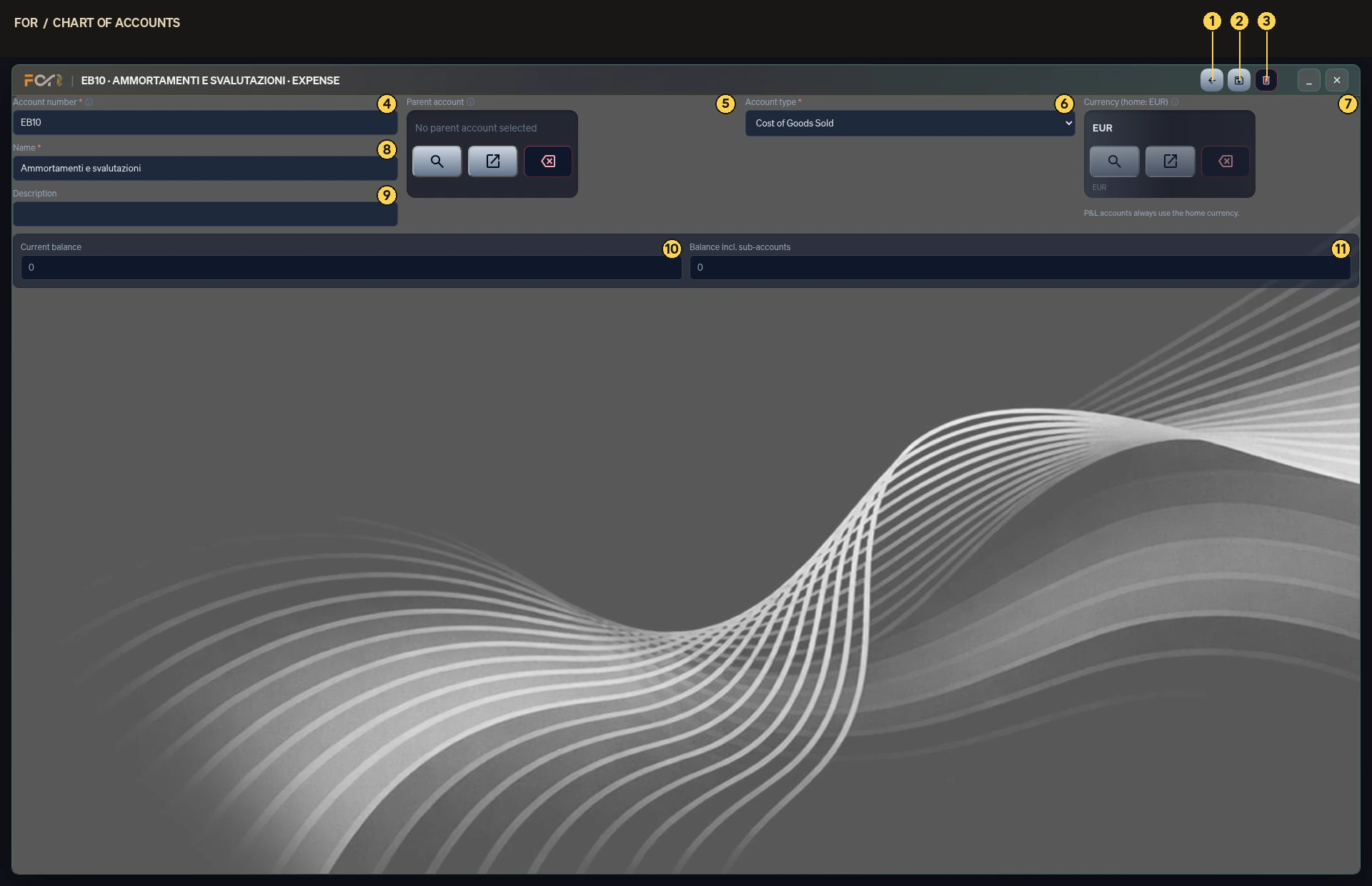
- 1
Back to list · left arrow
Return to the current document list. If the form has unsaved changes, decide explicitly whether to keep working or discard them. Going back is not Save and does not reverse a completed operation.
- 2
Save · disk
Validate and save the current form. On an accounting document this can post the financial transaction; on an operational draft it saves that stage only. Read the success or error message and final number. If the outcome is uncertain, reload/reconcile the same document instead of creating another.
- 3
Deactivate / Archive · trash
Remove the record from ordinary active choices while retaining its history. This is not a financial reversal. Project tags and budgets are archived with their historical assignments/amounts retained. Review the confirmation and any dependency warning; connected-bank accounts and protected tax/system choices may not be deactivated.
- 4
Account number
Use the account's established chart number. It helps ordering and recognition but does not change the account's financial type or replace a customer/vendor identity.
- 5
Parent account
Select the existing parent only when a hierarchical classification is intended and permitted. The full path identifies the hierarchy; selecting a parent does not merge the underlying records or their balances.
- 6
Account type
Choose the financial category that determines the account's role and which document pickers can offer it. Bank, credit card, receivables, payables, income and expense accounts are not interchangeable. Choices: Bank; Other Current Asset; Fixed Asset; Other Asset; Accounts Receivable; Equity; Expense; Other Expense; Cost of Goods Sold; Accounts Payable; Credit Card; Long Term Liability; Other Current Liability; Income; Other Income; Non-Posting (QBO system).
- 7
Currency
Check which currency applies to this value. Transaction prices and supplier costs may be in a foreign currency, while stock carrying values and company budgets use the stated home-currency basis. Do not change the currency label to perform a conversion.
- 8
Name
Use a recognizable business name so other users can find the correct record. Search for an existing match before adding another. Renaming a record does not merge its history with another record.
- 9
Description
Describe the product, service or work in enough detail for the next operator. Sales copy is intended for commercial documents; internal/purchasing copy describes the operational need. Expand the text editor to read long text without changing the row's meaning.
- 10
Current balance
Read the calculated/saved amount and its currency. Total is the document value, tax is its tax component, and balance/remaining credit is what is still available after applications. A displayed zero is different from an unavailable value; do not overwrite a result to force reconciliation.
- 11
Balance incl. sub-accounts
Read the calculated/saved amount and its currency. Total is the document value, tax is its tax component, and balance/remaining credit is what is still available after applications. A displayed zero is different from an unavailable value; do not overwrite a result to force reconciliation.
Complete the task
Choose and maintain the financial accounts used by documents, payments and reporting.
- Search the existing list and open the intended record before choosing New; review the exact field reference below.
- Complete the required choices and review their business effect, then Save only when the form is editable and the values are correct.
- Reopen the saved result and follow the linked workflow rather than making disconnected duplicates.
Saved, read-only and unavailable states
The saved record and its source workflow determine which fields can change. Read-only values stay visible for review; they are not broken inputs. Save/discard unsaved edits before an action that requires a clean source. If the result of an operation is uncertain, inspect and reconcile that same operation rather than repeating a new write.
Every field and control
Use the exact label or hover over an icon to match it to this reference. A missing action is not the same as an empty field: check its availability below.
Search · magnifying glass
ActionSearch this company's selected list by the visible document number, business name or descriptive words. Confirm the active company first. Search results do not widen your role permissions; clear the search to return to the ordinary filtered list.
Availability: List and lookup views. A source-specific picker can intentionally offer fewer records than the full list.
Include retained inactive/completed records when the list offers this control. Open order views exclude Draft, Closed and Cancelled; completed pick/pack tasks are normally found through Show inactive. Historical visibility does not reactivate or reopen a record.
Availability: Only when the list supports inactive or lifecycle filtering; choices depend on the document type.
Previous / Next / page size
ActionMove through the current filtered result set. The count refers to those filters, not the whole company. Changing filters starts a new result set; a short page does not by itself prove that unrelated records do not exist.
Availability: Paged lists; Previous/Next is disabled when no page exists in that direction.
Open a row
ActionSelect the record's main name/number to open its form. Email and phone links have their own communication actions. A linked count or financial balance can open the corresponding transaction rail rather than edit that total.
Availability: Requires permission to open the record. Reference-only roles receive only the permitted context.
Back to list · left arrow
ActionReturn to the current document list. If the form has unsaved changes, decide explicitly whether to keep working or discard them. Going back is not Save and does not reverse a completed operation.
Availability: Ordinary forms; a guided batch or specialized workflow can manage navigation itself.
Minimize · minus
ActionKeep this workspace open as a colored taskbar tile. Select that tile to restore the same window. Minimizing is not Save and does not cancel an operation already submitted.
Availability: Hosted workspace windows.
Close window · X
ActionClose this window, not the underlying record. Respect any unsaved-change or unfinished-operation warning. Closing a window never reverses a posted document, dispatched shipment or sent email.
Availability: Hosted workspace windows; an active workflow can require waiting or confirming navigation.
New · plus
ActionOpen a new form in the selected company. Check required identity fields, default date, currency and number before entering details. Opening a form is not confirmation of a completed transaction.
Availability: Only for records that can be authored directly and for users with create permission. System activity records have no standalone New.
Save · disk
ActionValidate and save the current form. On an accounting document this can post the financial transaction; on an operational draft it saves that stage only. Read the success or error message and final number. If the outcome is uncertain, reload/reconcile the same document instead of creating another.
Availability: Editable records with write permission; disabled while loading/saving or when a required dependency is unresolved.
Deactivate / Archive · trash
ActionRemove the record from ordinary active choices while retaining its history. This is not a financial reversal. Project tags and budgets are archived with their historical assignments/amounts retained. Review the confirmation and any dependency warning; connected-bank accounts and protected tax/system choices may not be deactivated.
Availability: Saved editable records only where the action is offered; protected, standard or workflow-owned records can hide or refuse it.
Open eligible choices for this exact field. Search by code/name and inspect the secondary description and badges. Product code matches take priority; Inventory, Non-inventory and Internal only explain eligibility, not interchangeable products.
Availability: Reference fields. Results can depend on customer/supplier, currency, warehouse, source line, active status and your role.
Open selected record
ActionOpen the selected customer, supplier, product, account or source document in its own workspace. Its category color follows the destination. This is navigation, not confirmation of the unsaved current form.
Availability: A resolved reference and permission to open it are required; read-only reference access does not grant master editing.
Clear selection · X
ActionRemove an editable field's current selection. It does not delete the referenced customer/product/document. Changing a party, currency or control account can require confirmation before incompatible draft applications are cleared.
Availability: Only editable, clearable selections; source-owned or required locked references stay protected.
ID
ColumnRead this saved-record summary before opening the row. Use the full form for the field's context and related documents; a list summary is not an editable posting field.
Availability: Read-only display; inspect the originating workflow to change its result.
Number
ColumnReview the suggested business number/code before saving. Where numbering is managed, the final saved number is authoritative and may advance if another document used the suggestion. Do not change a number to conceal a duplicate or rewrite history.
Availability: Read-only display; inspect the originating workflow to change its result.
Name
ColumnUse a recognizable business name so other users can find the correct record. Search for an existing match before adding another. Renaming a record does not merge its history with another record.
Availability: Read-only display; inspect the originating workflow to change its result.
Classification
ColumnRead this saved-record summary before opening the row. Use the full form for the field's context and related documents; a list summary is not an editable posting field.
Availability: Read-only display; inspect the originating workflow to change its result.
Type
ColumnChoose the business classification offered by this particular form and review the fields that appear afterward. A sales price rule, purchase price rule, document type and billing method have different scopes; the choice must match the intended workflow.
Availability: Read-only display; inspect the originating workflow to change its result.
Balance
ColumnRead the calculated/saved amount and its currency. Total is the document value, tax is its tax component, and balance/remaining credit is what is still available after applications. A displayed zero is different from an unavailable value; do not overwrite a result to force reconciliation.
Availability: Read-only display; inspect the originating workflow to change its result.
Name
FieldUse a recognizable business name so other users can find the correct record. Search for an existing match before adding another. Renaming a record does not merge its history with another record.
Availability: Required when this field is offered for an editable record. Maximum 100 characters.
Account number
FieldUse the account's established chart number. It helps ordering and recognition but does not change the account's financial type or replace a customer/vendor identity.
Availability: Editable only when your role, document state and the source workflow allow it; not every country or document variant shows this field. Maximum 20 characters.
Description
FieldDescribe the product, service or work in enough detail for the next operator. Sales copy is intended for commercial documents; internal/purchasing copy describes the operational need. Expand the text editor to read long text without changing the row's meaning.
Availability: Editable only when your role, document state and the source workflow allow it; not every country or document variant shows this field. Maximum 4000 characters.
Parent account
FieldSelect the existing parent only when a hierarchical classification is intended and permitted. The full path identifies the hierarchy; selecting a parent does not merge the underlying records or their balances.
Availability: Editable only when your role, document state and the source workflow allow it; not every country or document variant shows this field. Lookup results are limited to eligible records; a read-only lookup grants no editing permission.
Account type
FieldChoose the financial category that determines the account's role and which document pickers can offer it. Bank, credit card, receivables, payables, income and expense accounts are not interchangeable. Choices: Bank; Other Current Asset; Fixed Asset; Other Asset; Accounts Receivable; Equity; Expense; Other Expense; Cost of Goods Sold; Accounts Payable; Credit Card; Long Term Liability; Other Current Liability; Income; Other Income; Non-Posting (QBO system).
Availability: Required when this field is offered for an editable record.
Currency
FieldCheck which currency applies to this value. Transaction prices and supplier costs may be in a foreign currency, while stock carrying values and company budgets use the stated home-currency basis. Do not change the currency label to perform a conversion.
Availability: Editable only when your role, document state and the source workflow allow it; not every country or document variant shows this field. Lookup results are limited to eligible records; a read-only lookup grants no editing permission.
Current balance
FieldRead the calculated/saved amount and its currency. Total is the document value, tax is its tax component, and balance/remaining credit is what is still available after applications. A displayed zero is different from an unavailable value; do not overwrite a result to force reconciliation.
Availability: Read-only display; inspect the originating workflow to change its result.
Read the calculated/saved amount and its currency. Total is the document value, tax is its tax component, and balance/remaining credit is what is still available after applications. A displayed zero is different from an unavailable value; do not overwrite a result to force reconciliation.
Availability: Read-only display; inspect the originating workflow to change its result.
Watch the workflow

This recording is temporarily unavailable. Please try again later.
Shared workflow
Record a journal entry
Read the steps
- Choose the accounts, enter debit and credit lines, and review the balanced journal before saving.