
Inventory products
Define what you physically stock, buy and make. Stock unit, purchase/make unit, tracking mode and financial association must reflect the real product.
Open this screen
Command launcher → Inventory → Inventory product. Choose New, Edit/Search or List only as offered.
When it is available
Available to users whose company roles permit this work. Country, subscription, company settings and the saved record's state can narrow the available controls.
QuickBooks connection
The operational document and its quantities are maintained in FOR, not as a QuickBooks inventory workflow. In FOR:LEDGER, a linked invoice, bill or payment is the supported accounting step written to QuickBooks; a stock receipt or shipment is not by itself another QuickBooks financial document. Do not create a duplicate accounting document for a completed linked step. FOR:CEO keeps the operation and its supported inventory-value accounting in FOR.
- 1
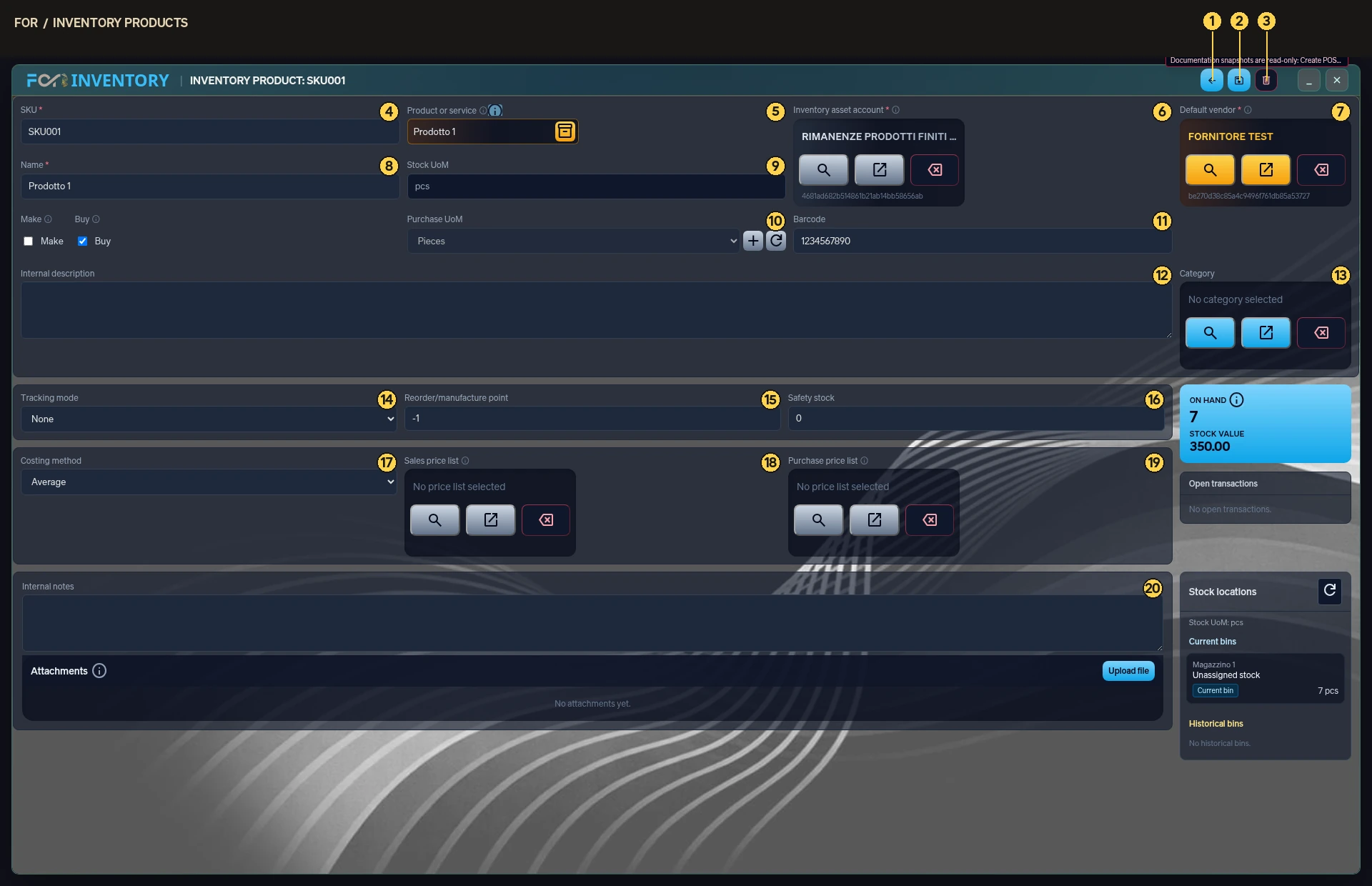
Back to list · left arrow
Return to the current document list. If the form has unsaved changes, decide explicitly whether to keep working or discard them. Going back is not Save and does not reverse a completed operation.
- 2
Save · disk
Validate and save the current form. On an accounting document this can post the financial transaction; on an operational draft it saves that stage only. Read the success or error message and final number. If the outcome is uncertain, reload/reconcile the same document instead of creating another.
- 3
Deactivate / Archive · trash
Remove the record from ordinary active choices while retaining its history. This is not a financial reversal. Project tags and budgets are archived with their historical assignments/amounts retained. Review the confirmation and any dependency warning; connected-bank accounts and protected tax/system choices may not be deactivated.
- 4
SKU
Use the established business code, keeping meaningful leading zeros and punctuation. Product searches prioritize exact and partial code matches. A barcode is the scanned identity, not a quantity or selling price.
- 5
Product or service
Select the existing financial product or service using the lookup, checking the displayed identity and context before choosing. The open-record icon reads the selected record when your role permits it; clear removes only the draft selection, not the referenced record.
- 6
Inventory asset account
Choose the balance-sheet or accumulated-depreciation account required by this product/asset plan. Review it before the first posting: established inventory and managed-asset account ownership can restrict later changes.
- 7
Default vendor
Select the existing supplier using the lookup, checking the displayed identity and context before choosing. The open-record icon reads the selected record when your role permits it; clear removes only the draft selection, not the referenced record.
- 8
Name
Use a recognizable business name so other users can find the correct record. Search for an existing match before adding another. Renaming a record does not merge its history with another record.
- 9
Stock UoM
Read the unit attached to this quantity. Stock/sales and component quantities use the stock unit; purchase/make quantities may use a different reviewed unit. Source-linked documents retain their original conversion, so a later catalogue change does not reinterpret past quantities. Choices: Pieces; Each; Unit; Box; Carton; Pallet; Pack; Set; Pair; Roll; Sheet; Kilogram; Gram; Tonne; Pound; Ounce; Litre; Millilitre; Gallon; Metre; Centimetre; Millimetre; Inch; Foot; Square metre; Cubic metre; Hour; Day.
- 10
Purchase UoM
Read the unit attached to this quantity. Stock/sales and component quantities use the stock unit; purchase/make quantities may use a different reviewed unit. Source-linked documents retain their original conversion, so a later catalogue change does not reinterpret past quantities. Choices: Pieces; Each; Unit; Box; Carton; Pallet; Pack; Set; Pair; Roll; Sheet; Kilogram; Gram; Tonne; Pound; Ounce; Litre; Millilitre; Gallon; Metre; Centimetre; Millimetre; Inch; Foot; Square metre; Cubic metre; Hour; Day.
- 11
Barcode
Use the established business code, keeping meaningful leading zeros and punctuation. Product searches prioritize exact and partial code matches. A barcode is the scanned identity, not a quantity or selling price.
- 12
Internal description
Describe the product, service or work in enough detail for the next operator. Sales copy is intended for commercial documents; internal/purchasing copy describes the operational need. Expand the text editor to read long text without changing the row's meaning.
- 13
Category
Choose the actual business case shown by the available choices, such as purchase receiving versus customer return, material issue versus return, or good output versus scrap. Review the source and quantity controls after changing it; the cases have different stock and valuation effects.
- 14
Tracking mode
Choose None, Lot or Serial. A product uses one tracking mode, not lot and serial simultaneously. Once tracked stock has been used the mode is protected; switching an untracked product to tracking requires verified zero on-hand stock. Choices: None; Lot; Serial.
- 15
Reorder/manufacture point
Set the planning threshold or lead time used to flag replenishment needs. These values inform purchasing/manufacturing decisions; editing them does not order goods, make stock or change the on-hand balance.
- 16
Safety stock
Set the planning threshold or lead time used to flag replenishment needs. These values inform purchasing/manufacturing decisions; editing them does not order goods, make stock or change the on-hand balance.
- 17
Costing method
Choose the supported inventory valuation method deliberately before stock is used. Review how the displayed standard/average cost relates to receipts and outputs; changing a caption does not recalculate historical movements. Choices: Average; Fifo; Standard.
- 18
Sales price list
Select the existing eligible price rule using the lookup, checking the displayed identity and context before choosing. The open-record icon reads the selected record when your role permits it; clear removes only the draft selection, not the referenced record.
- 19
Purchase price list
Select the existing eligible price rule using the lookup, checking the displayed identity and context before choosing. The open-record icon reads the selected record when your role permits it; clear removes only the draft selection, not the referenced record.
- 20
Internal notes
Record the business explanation or reference needed to understand this work later. Internal notes are not the customer/vendor message. Keep source references already present and do not put access passwords or payment-card details here.
Complete the task
Define what you physically stock, buy and make. Stock unit, purchase/make unit, tracking mode and financial association must reflect the real product.
- Choose a unique code, internal/sales descriptions and category. Internal-only materials need no financial sales product; selling them requires an eligible finance association.
- Set Stock UoM and Purchase/Make UoM with the reviewed conversion. Enable Buy and/or Make according to the sourcing process, and set cost/stock accounts carefully.
- Choose None, Lot or Serial tracking before stock is used. Existing tracked stock cannot be relabelled by changing the mode; enabling tracking on untracked stock requires zero on hand.
- Use Stock details and Stock locations to inspect quantities and bins. Correct stock through receiving, adjustment, count or transfer, never by editing an on-hand total.
Saved, read-only and unavailable states
The saved record and its source workflow determine which fields can change. Read-only values stay visible for review; they are not broken inputs. Save/discard unsaved edits before an action that requires a clean source. If the result of an operation is uncertain, inspect and reconcile that same operation rather than repeating a new write.
Inventory-value accounting
FOR:CEO ONLYSupported receipts, dispatches and adjustments also affect the native stock-value accounts through their owned journals. Review the item's configured accounts, valuation/cost and posting status. A failed or uncertain posting must be reconciled through its original operation; do not create an unrelated replacement journal. Closed-book protections still apply.
Every field and control
Use the exact label or hover over an icon to match it to this reference. A missing action is not the same as an empty field: check its availability below.
Search · magnifying glass
ActionSearch this company's selected list by the visible document number, business name or descriptive words. Confirm the active company first. Search results do not widen your role permissions; clear the search to return to the ordinary filtered list.
Availability: List and lookup views. A source-specific picker can intentionally offer fewer records than the full list.
Include retained inactive/completed records when the list offers this control. Open order views exclude Draft, Closed and Cancelled; completed pick/pack tasks are normally found through Show inactive. Historical visibility does not reactivate or reopen a record.
Availability: Only when the list supports inactive or lifecycle filtering; choices depend on the document type.
Previous / Next / page size
ActionMove through the current filtered result set. The count refers to those filters, not the whole company. Changing filters starts a new result set; a short page does not by itself prove that unrelated records do not exist.
Availability: Paged lists; Previous/Next is disabled when no page exists in that direction.
Open a row
ActionSelect the record's main name/number to open its form. Email and phone links have their own communication actions. A linked count or financial balance can open the corresponding transaction rail rather than edit that total.
Availability: Requires permission to open the record. Reference-only roles receive only the permitted context.
Back to list · left arrow
ActionReturn to the current document list. If the form has unsaved changes, decide explicitly whether to keep working or discard them. Going back is not Save and does not reverse a completed operation.
Availability: Ordinary forms; a guided batch or specialized workflow can manage navigation itself.
Minimize · minus
ActionKeep this workspace open as a colored taskbar tile. Select that tile to restore the same window. Minimizing is not Save and does not cancel an operation already submitted.
Availability: Hosted workspace windows.
Close window · X
ActionClose this window, not the underlying record. Respect any unsaved-change or unfinished-operation warning. Closing a window never reverses a posted document, dispatched shipment or sent email.
Availability: Hosted workspace windows; an active workflow can require waiting or confirming navigation.
New · plus
ActionOpen a new form in the selected company. Check required identity fields, default date, currency and number before entering details. Opening a form is not confirmation of a completed transaction.
Availability: Only for records that can be authored directly and for users with create permission. System activity records have no standalone New.
Save · disk
ActionValidate and save the current form. On an accounting document this can post the financial transaction; on an operational draft it saves that stage only. Read the success or error message and final number. If the outcome is uncertain, reload/reconcile the same document instead of creating another.
Availability: Editable records with write permission; disabled while loading/saving or when a required dependency is unresolved.
Deactivate / Archive · trash
ActionRemove the record from ordinary active choices while retaining its history. This is not a financial reversal. Project tags and budgets are archived with their historical assignments/amounts retained. Review the confirmation and any dependency warning; connected-bank accounts and protected tax/system choices may not be deactivated.
Availability: Saved editable records only where the action is offered; protected, standard or workflow-owned records can hide or refuse it.
Open eligible choices for this exact field. Search by code/name and inspect the secondary description and badges. Product code matches take priority; Inventory, Non-inventory and Internal only explain eligibility, not interchangeable products.
Availability: Reference fields. Results can depend on customer/supplier, currency, warehouse, source line, active status and your role.
Open selected record
ActionOpen the selected customer, supplier, product, account or source document in its own workspace. Its category color follows the destination. This is navigation, not confirmation of the unsaved current form.
Availability: A resolved reference and permission to open it are required; read-only reference access does not grant master editing.
Clear selection · X
ActionRemove an editable field's current selection. It does not delete the referenced customer/product/document. Changing a party, currency or control account can require confirmation before incompatible draft applications are cleared.
Availability: Only editable, clearable selections; source-owned or required locked references stay protected.
Choose a supported evidence file, wait for upload completion and review its name before saving. Ordinary form files are limited to 25 MB each. A file upload alone is not a new accounting document or successful email.
Availability: Editable attachment panels. Protected original electronic documents have a separate read-only file area.
Open / download attachment
ActionRead the selected file belonging to this document. Generated invoice PDF, supplier-original attachments and your manually uploaded files can be different files. A pending or failed retrieval is not the same as no attachment.
Availability: Available files and authorized document access. Reading does not modify the bill, trigger a new receipt or resend email.
Remove attachment
ActionRemove only an editable file association after checking that the evidence is no longer required. This does not delete the financial document; protected received originals cannot be removed through this control.
Availability: Only removable, non-protected attachments on an editable form.
SKU
ColumnUse the established business code, keeping meaningful leading zeros and punctuation. Product searches prioritize exact and partial code matches. A barcode is the scanned identity, not a quantity or selling price.
Availability: Read-only display; inspect the originating workflow to change its result.
Name
ColumnUse a recognizable business name so other users can find the correct record. Search for an existing match before adding another. Renaming a record does not merge its history with another record.
Availability: Read-only display; inspect the originating workflow to change its result.
Category
ColumnChoose the actual business case shown by the available choices, such as purchase receiving versus customer return, material issue versus return, or good output versus scrap. Review the source and quantity controls after changing it; the cases have different stock and valuation effects.
Availability: Read-only display; inspect the originating workflow to change its result.
Sold as
ColumnRead this saved-record summary before opening the row. Use the full form for the field's context and related documents; a list summary is not an editable posting field.
Availability: Read-only display; inspect the originating workflow to change its result.
On hand
ColumnRead this saved-record summary before opening the row. Use the full form for the field's context and related documents; a list summary is not an editable posting field.
Availability: Read-only display; inspect the originating workflow to change its result.
Available
ColumnRead this saved-record summary before opening the row. Use the full form for the field's context and related documents; a list summary is not an editable posting field.
Availability: Read-only display; inspect the originating workflow to change its result.
To ship
ColumnRead this saved-record summary before opening the row. Use the full form for the field's context and related documents; a list summary is not an editable posting field.
Availability: Read-only display; inspect the originating workflow to change its result.
On SO
ColumnRead this saved-record summary before opening the row. Use the full form for the field's context and related documents; a list summary is not an editable posting field.
Availability: Read-only display; inspect the originating workflow to change its result.
Allocated to MO
ColumnRead this saved-record summary before opening the row. Use the full form for the field's context and related documents; a list summary is not an editable posting field.
Availability: Read-only display; inspect the originating workflow to change its result.
On PO
ColumnRead this saved-record summary before opening the row. Use the full form for the field's context and related documents; a list summary is not an editable posting field.
Availability: Read-only display; inspect the originating workflow to change its result.
Safety
ColumnRead this saved-record summary before opening the row. Use the full form for the field's context and related documents; a list summary is not an editable posting field.
Availability: Read-only display; inspect the originating workflow to change its result.
Reorder point
ColumnRead this saved-record summary before opening the row. Use the full form for the field's context and related documents; a list summary is not an editable posting field.
Availability: Read-only display; inspect the originating workflow to change its result.
Missing
ColumnRead this saved-record summary before opening the row. Use the full form for the field's context and related documents; a list summary is not an editable posting field.
Availability: Read-only display; inspect the originating workflow to change its result.
SKU
FieldUse the established business code, keeping meaningful leading zeros and punctuation. Product searches prioritize exact and partial code matches. A barcode is the scanned identity, not a quantity or selling price.
Availability: Required when this field is offered for an editable record.
Product or service
FieldSelect the existing financial product or service using the lookup, checking the displayed identity and context before choosing. The open-record icon reads the selected record when your role permits it; clear removes only the draft selection, not the referenced record.
Availability: Editable only when your role, document state and the source workflow allow it; not every country or document variant shows this field. Lookup results are limited to eligible records; a read-only lookup grants no editing permission.
Inventory asset account
FieldChoose the balance-sheet or accumulated-depreciation account required by this product/asset plan. Review it before the first posting: established inventory and managed-asset account ownership can restrict later changes.
Availability: Required when this field is offered for an editable record. Lookup results are limited to eligible records; a read-only lookup grants no editing permission.
Default vendor
FieldSelect the existing supplier using the lookup, checking the displayed identity and context before choosing. The open-record icon reads the selected record when your role permits it; clear removes only the draft selection, not the referenced record.
Availability: Editable only when your role, document state and the source workflow allow it; not every country or document variant shows this field. Lookup results are limited to eligible records; a read-only lookup grants no editing permission.
Name
FieldUse a recognizable business name so other users can find the correct record. Search for an existing match before adding another. Renaming a record does not merge its history with another record.
Availability: Required when this field is offered for an editable record.
Barcode
FieldUse the established business code, keeping meaningful leading zeros and punctuation. Product searches prioritize exact and partial code matches. A barcode is the scanned identity, not a quantity or selling price.
Availability: Editable only when your role, document state and the source workflow allow it; not every country or document variant shows this field.
Category
FieldChoose the actual business case shown by the available choices, such as purchase receiving versus customer return, material issue versus return, or good output versus scrap. Review the source and quantity controls after changing it; the cases have different stock and valuation effects.
Availability: Editable only when your role, document state and the source workflow allow it; not every country or document variant shows this field. Lookup results are limited to eligible records; a read-only lookup grants no editing permission.
Default purchase price
FieldMark only the intended base/fallback rule. A sales default must be a fixed product price without customer/scope/category, and only one active default is allowed for a product/currency. Specific matching overrides can still take precedence.
Availability: Editable only when your role, document state and the source workflow allow it; not every country or document variant shows this field.
Stock UoM
FieldRead the unit attached to this quantity. Stock/sales and component quantities use the stock unit; purchase/make quantities may use a different reviewed unit. Source-linked documents retain their original conversion, so a later catalogue change does not reinterpret past quantities. Choices: Pieces; Each; Unit; Box; Carton; Pallet; Pack; Set; Pair; Roll; Sheet; Kilogram; Gram; Tonne; Pound; Ounce; Litre; Millilitre; Gallon; Metre; Centimetre; Millimetre; Inch; Foot; Square metre; Cubic metre; Hour; Day.
Availability: Editable only when your role, document state and the source workflow allow it; not every country or document variant shows this field.
Make
FieldChoose the sourcing capability that matches this product/order. Buy allows purchasing, Make identifies production eligibility, and drop shipping describes direct delivery where supported. None of these switches by itself creates a purchase or manufacturing order.
Availability: Editable only when your role, document state and the source workflow allow it; not every country or document variant shows this field.
Buy
FieldChoose the sourcing capability that matches this product/order. Buy allows purchasing, Make identifies production eligibility, and drop shipping describes direct delivery where supported. None of these switches by itself creates a purchase or manufacturing order.
Availability: Editable only when your role, document state and the source workflow allow it; not every country or document variant shows this field.
Purchase UoM
FieldRead the unit attached to this quantity. Stock/sales and component quantities use the stock unit; purchase/make quantities may use a different reviewed unit. Source-linked documents retain their original conversion, so a later catalogue change does not reinterpret past quantities. Choices: Pieces; Each; Unit; Box; Carton; Pallet; Pack; Set; Pair; Roll; Sheet; Kilogram; Gram; Tonne; Pound; Ounce; Litre; Millilitre; Gallon; Metre; Centimetre; Millimetre; Inch; Foot; Square metre; Cubic metre; Hour; Day.
Availability: Editable only when your role, document state and the source workflow allow it; not every country or document variant shows this field.
Bill of materials
FieldSelect the existing current bill of materials using the lookup, checking the displayed identity and context before choosing. The open-record icon reads the selected record when your role permits it; clear removes only the draft selection, not the referenced record.
Availability: Editable only when your role, document state and the source workflow allow it; not every country or document variant shows this field. Lookup results are limited to eligible records; a read-only lookup grants no editing permission.
Internal description
FieldDescribe the product, service or work in enough detail for the next operator. Sales copy is intended for commercial documents; internal/purchasing copy describes the operational need. Expand the text editor to read long text without changing the row's meaning.
Availability: Editable only when your role, document state and the source workflow allow it; not every country or document variant shows this field.
Tracking mode
FieldChoose None, Lot or Serial. A product uses one tracking mode, not lot and serial simultaneously. Once tracked stock has been used the mode is protected; switching an untracked product to tracking requires verified zero on-hand stock. Choices: None; Lot; Serial.
Availability: Editable only when your role, document state and the source workflow allow it; not every country or document variant shows this field.
Set the planning threshold or lead time used to flag replenishment needs. These values inform purchasing/manufacturing decisions; editing them does not order goods, make stock or change the on-hand balance.
Availability: Editable only when your role, document state and the source workflow allow it; not every country or document variant shows this field.
Safety stock
FieldSet the planning threshold or lead time used to flag replenishment needs. These values inform purchasing/manufacturing decisions; editing them does not order goods, make stock or change the on-hand balance.
Availability: Editable only when your role, document state and the source workflow allow it; not every country or document variant shows this field.
Costing method
FieldChoose the supported inventory valuation method deliberately before stock is used. Review how the displayed standard/average cost relates to receipts and outputs; changing a caption does not recalculate historical movements. Choices: Average; Fifo; Standard.
Availability: Editable only when your role, document state and the source workflow allow it; not every country or document variant shows this field.
Expense / COGS account
FieldChoose the cost account appropriate to the business event. Expense and cost-of-sales classifications affect reporting; an asset acquisition should not be expensed merely because it is easier to find an account.
Availability: Editable only when your role, document state and the source workflow allow it; not every country or document variant shows this field. Lookup results are limited to eligible records; a read-only lookup grants no editing permission.
Sales price list
FieldSelect the existing eligible price rule using the lookup, checking the displayed identity and context before choosing. The open-record icon reads the selected record when your role permits it; clear removes only the draft selection, not the referenced record.
Availability: Editable only when your role, document state and the source workflow allow it; not every country or document variant shows this field. Lookup results are limited to eligible records; a read-only lookup grants no editing permission.
Purchase price list
FieldSelect the existing eligible price rule using the lookup, checking the displayed identity and context before choosing. The open-record icon reads the selected record when your role permits it; clear removes only the draft selection, not the referenced record.
Availability: Editable only when your role, document state and the source workflow allow it; not every country or document variant shows this field. Lookup results are limited to eligible records; a read-only lookup grants no editing permission.
Standard cost
FieldUse the cost in the displayed unit and currency, not the customer's selling price. Receiving, returns and production may carry a verified source cost that cannot be replaced by today's price. Zero is a real zero cost only when confirmed, not a substitute for a missing value.
Availability: Editable only when your role, document state and the source workflow allow it; not every country or document variant shows this field.
Internal notes
FieldRecord the business explanation or reference needed to understand this work later. Internal notes are not the customer/vendor message. Keep source references already present and do not put access passwords or payment-card details here.
Availability: Editable only when your role, document state and the source workflow allow it; not every country or document variant shows this field. Maximum 4000 characters.
Add the relevant evidence files and verify their names before saving. Open/download reads the selected file; removing an editable attachment removes that association, not the original financial transaction. Protected received electronic files are read-only and cannot be removed from this panel.
Availability: Editable only when your role, document state and the source workflow allow it; not every country or document variant shows this field. FOR:CEO only.
Watch the workflow

This recording is temporarily unavailable. Please try again later.
Shared workflow
Customers, suppliers and products
Read the steps
- Create customer records using website location discovery or supported VAT-registration lookup, then review the details.
- Use the supplier workflow to review identity, contact information and billing address before saving.
- Define a service or sales product and its accounting and tax settings.
- Link a stocked product to its inventory record, units, supplier and asset account.
- Internal components can be purchased or consumed in production without being offered as sales products.
- Set up a manufactured product, enable Make and connect its bill of materials and operational settings.